By PoppaDukes Serrano, Executive Producer & Host, The OG Social Network Podcast
Trump, Congress, and Schedule III: Does Federal Rescheduling Really Matter for NY Cannabis in 2026?
Let’s keep it a buck. Every few months, the headlines start buzzing again. “Federal rescheduling is coming!” “Cannabis move to Schedule III!” And every time, folks in the Bronx, Harlem, and across New York ask the same question. They say, “Does any of this actually matter for us?”
Because on the ground? The NY hustle doesn’t pause for federal press conferences. It’s rent, payroll, and compliance. It’s also trying to keep the doors open while the politics bounce from Congress to the DEA and back again.
And yeah—this moment is loaded with bigger narratives too. These include #politics, #elections, and #midterms. It also involves the way power blocs shape policy. This ranges from lobby influence like #aipac to culture-war posturing around #trump. Yet, the street-level reality in NY is different. It boils down to one question. Can operators survive long enough to become legitimate without losing their shirts?
So let’s break it down—no fluff, no spin. Here’s the real talk on what federal rescheduling means for the grassroots cannabis movement. It’s about the social equity entrepreneurs grinding every day. We explore whether Washington’s moves are game-changing or just more noise.
The Schedule III Situation: What’s Actually Happening?
Here’s the deal. Congress and the executive branch have discussed moving cannabis from Schedule I (the same category as heroin). They want to move it to Schedule III (alongside drugs like ketamine and testosterone). This discussion has been ongoing for a while. The DEA had hearings scheduled, postponed, rescheduled—you know the drill.
As of early 2026, rescheduling is considered “highly probable” but still not guaranteed. There are still administrative hurdles, DEA processes, lawsuits, and plain old election-year maneuvering. That’s the part folks forget: in the U.S., drug policy isn’t just science—it’s #USLaw, messaging, and who’s trying to look “tough” or “reasonable” on TV.
Scheduling History: Control, Not Just Health
Real talk: cannabis scheduling has a history tied to political control. The modern scheduling system comes from the Controlled Substances Act of 1970. This framework has been used for decades to police communities. It shapes budgets and justifies enforcement priorities. That’s not “conspiracy talk,” that’s American history. If you want the receipts, start with the CSA itself: https://www.deadiversion.usdoj.gov/21cfr/21usc/
And when people say “it was never about safety,” look at the inconsistency. Alcohol and tobacco stay legal, but cannabis got treated like a national threat. To a lot of New Yorkers, rescheduling feels like the framework quietly admitting it overreached. It does this without really apologizing, compensating, or repairing harm. That’s the #constitution conversation too. It involves how we talk about rights and equal protection. It also addresses who gets targeted when “public safety” becomes the excuse.
But here’s the part that most headlines don’t tell you: Federal rescheduling does NOT legalize cannabis.
Read that again.
Moving to Schedule III doesn’t mean your cousin can suddenly fly with an eighth in his carry-on. It doesn’t mean the feds are suddenly cool with your dispensary. New York’s regulatory framework—the licensing, the compliance, the Metrc tracking—stays exactly the same.
And that’s the disconnect: federal headlines sound like “victory.” But, NY operators still wake up to the same rules. They face the same city politics and the same day-to-day pressure. That’s why the NY #newyorkcannabiscommunity keeps building locally while DC argues nationally.

The push for Schedule III rescheduling has major implications for diversity and equity in the national cannabis industry.
The 280E Tax Nightmare: This Is Where It Gets Real
Now, here’s where rescheduling actually matters. It’s all about the money. This includes #taxpayers money, operator money, and who gets to survive long enough to become a “success story.”
Section 280E of the Internal Revenue Code has been crushing cannabis businesses since day one. Under current law, cannabis operators can’t deduct ordinary business expenses like:
- Rent
- Payroll
- Marketing
- Professional services (legal, accounting)
- Security
- Insurance
- Basically anything except cost of goods sold
The result? Some operators are paying effective tax rates of 50%–70%+ depending on margins and structure. The IRS lays out the rule here (straight from the source): https://www.irs.gov/newsroom/irs-reminds-businesses-that-trafficking-in-controlled-substances-is-prohibited
The Specific 280E Pain for Legacy Operators Transitioning in NY
This is where the federal headlines don’t match the street reality.
Many NY “legacy” operators trying to go legit lack a clean corporate setup. They don’t have a bank relationship or a pile of investor capital. They’re starting with community trust, real customer demand, and maybe a small crew. Then the legal market hits them with:
- High build-out costs (security, cameras, compliant storage)
- Licensing fees and professional services
- Slower ramp-up because regulated supply chains take time
- Higher pricing pressure because consumers still compare everything to the street
Now stack 280E on top of that. Here’s a simple example to show why this hits so hard:
- A small dispensary does $1,500,000 in annual sales
- Their COGS is $900,000 (product isn’t cheap in a regulated system)
- Gross profit: $600,000
- Normal operating expenses (rent, payroll, security, marketing, insurance, compliance): $500,000
- Real “business profit” before tax: $100,000
In a normal business, you’d pay tax on about $100,000.
Under 280E, you can’t deduct that $500,000 in operating costs the same way. So you may get taxed on something closer to $600,000 (depending on accounting and what qualifies as COGS). That’s how you end up with a tax bill that can wipe out the entire year—and then some.
That’s why legacy-to-legal isn’t just “get a license and you’re good.” It’s: can you survive the first 12–24 months without getting taxed like you’re a cartel? That’s the real question for #cannabisentrepreneursnyc trying to transition.
For the big Multi-State Operators (MSOs) with deep pockets and fancy accountants? They’ve found strategies to soften the blow. They structure entities, centralize services, and fight over what counts as COGS.
For the social equity licensee in the Bronx, there’s a significant financial challenge. The trailblazer woman operator, who finally opened her doors after years of red tape, also faces it. 280E transforms legal ownership into a financial choke-hold. (Like one operator told me off-mic, “I’m licensed… but I’m still treated like I’m illegal.”)
If Schedule III happens, 280E goes away. Cannabis businesses will finally deduct expenses like any other business. That’s not hype. That’s immediate, measurable cash flow relief. It is the difference between closing in year one and becoming a neighborhood powerhouse in year three.
Banking: Still a Nightmare in 2026
Let’s talk about something that affects every single cannabis entrepreneur in New York: banking.
You know the story. Most banks won’t touch cannabis money. Even in 2026, minority-owned dispensaries are:
- Paying crazy fees for “cannabis-friendly” financial services
- Operating in cash-heavy environments (hello, security risks)
- Getting denied for business loans and credit lines
- Struggling to build the credit history needed to grow
Does Schedule III fix this? Partially.
Rescheduling would reduce some of the federal risk that keeps big banks away. Here’s the truth. Comprehensive banking reform like the SAFE Banking Act must pass. Without it, many financial institutions will still stay on the sidelines.
And let’s keep it street. Even when a bank will work with cannabis, the fees are wild. The compliance is heavy. They can still pull the plug if they get spooked by a policy shift. That’s why NY operators still deal with:
- Cash-heavy operations (security risks, robbery risks)
- Limited lending (no real credit building)
- Higher processing costs than “normal” businesses
So when the news says “feds are moving cannabis,” a lot of folks hear “cool, banks are coming.” But on the block? It’s still, “Where do I deposit? Who’ll underwrite? Who’ll insure me?” Federal headlines don’t automatically turn into local access.
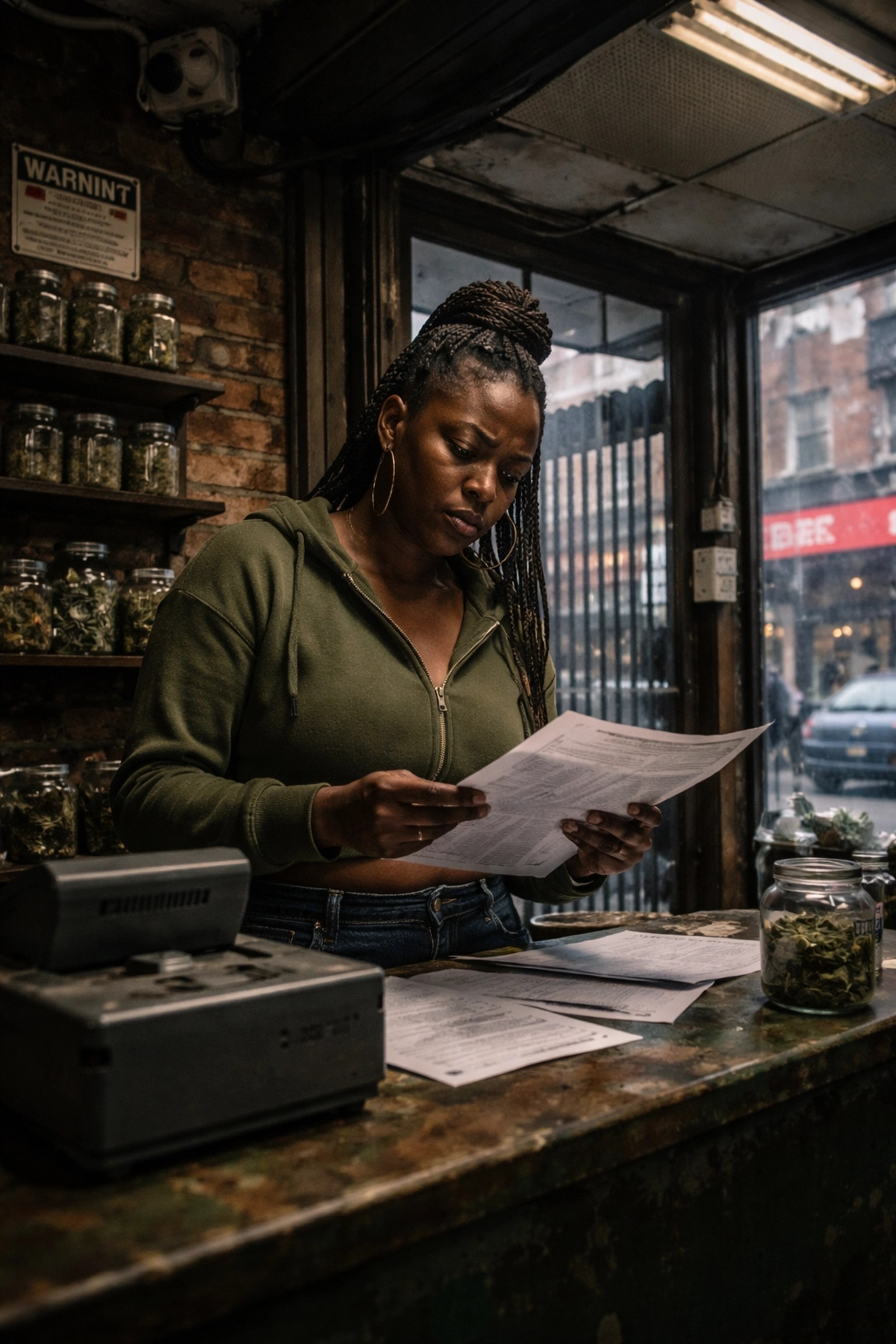
Minority cannabis business owners in the Bronx and across NYC face systemic financial hurdles that rescheduling alone won’t fix.
Does Any of This Help Social Equity Entrepreneurs?
This is the question that matters most to The OG Social Network community. Does federal rescheduling actually help the people who were most harmed by the War on Drugs?
Let’s break it down:
What rescheduling DOES do:
- Eliminates 280E tax burden (major win)
- Opens up more research opportunities
- Slightly reduces banking fears
- Creates political momentum for further reform
What rescheduling DOES NOT do:
- Change New York’s licensing structure
- Automatically help those denied licenses
- Address the capital access gap
- Fix the oversaturation in some markets
- Remove local municipality opt-outs
Here’s the uncomfortable truth: The biggest barriers facing social equity operators in New York are state and local issues. They are not federal ones.
We’ve covered this before on the podcast. When Dr. Chanda Macias talked about being a Black woman in a male-dominated industry, she wasn’t talking about federal scheduling. She was talking about access to capital. She mentioned respect in the boardroom. There are systemic barriers that no congressional vote will fix overnight.
(“Less than 3% of cannabis businesses receive traditional funding”: and that number is even worse for minority-owned operations.)
What NY Operators Should Actually Focus On
Look, I’m not saying ignore federal politics. If 280E disappears, that’s a real win. Celebrate it. Use those savings to grow your business, pay your team better, and invest in your community.
But don’t wait around for Washington to save you. Here’s what actually moves the needle in 2026. This is particularly true in NY where the legal market and the legacy market are still competing in real time.
The Federal Headline vs. NY Street Reality
This is the part I want you to sit with: federal reform can be true. It still might not feel real in NY.
You’ll see a headline about rescheduling and think “we’re finally free.” Meanwhile:
- A legacy operator is still trying to “transition” while prices are squeezed and enforcement is uneven
- A new legal operator is still battling delayed payouts, expensive compliance, and limited banking
- Consumers are still shopping on price and convenience, not ideology
- Neighborhoods still remember who got locked up—and who didn’t
So yeah, the macro conversation is #globalization and national politics. But the micro reality is local: who gets licensed, who gets capital, who gets raided, and who gets protected.
What NY Operators Should Actually Focus On
Build community connections. The operators thriving right now are the ones embedded in their neighborhoods. They’re sponsoring local events, hiring locally, and becoming trusted community members. That’s why we keep pushing #cannabisnetworkingevents through The OG Social Network Podcast—because relationships move faster than bureaucracy.
And if you’re trying to build that community muscle, this is where our culture-and-commerce link-ups matter:
- Farm days and education runs like #hudsoncannabisfarm
- Experiences like #longislandcannabistours
- Real-deal #weedfarmsyoucanvisit content that shows people the supply chain, not just the storefront
- On-the-ground #cannabisfarmtoursnewyork that connect consumers, operators, and advocates
Get your compliance tight. New York’s regulatory environment isn’t getting easier. Proteus420 is a good example of operator support. It helps businesses stay ahead of the rules. It keeps them from losing their minds.
Network with purpose. Connect with other social equity operators. Share resources. Learn from each other’s mistakes. This industry is still being built. The people building it together will be the ones standing when the dust settles. That’s the whole vibe behind #potsocialnetwork and why we keep centering the #newyorkcannabiscommunity.
Advocate locally. Your city council and your state reps make decisions that affect your license, your zoning, and your ability to operate. Federal rescheduling means nothing if your municipality opts out—or if local enforcement creates “rules for some people” energy.
And if you care about equity, keep the pressure on. NY needs consistent #cannabisactivismnewyork, especially around who gets funded, who gets mentorship, and who gets protected. We also need more spotlight on #womenincannabisnewyork—because representation isn’t a hashtag, it’s ownership, jobs, and long-term wealth.

Real change for cannabis justice comes from the ground up, starting with community and criminal justice reform.
The Bottom Line: Real Change Comes From the Ground Up
Federal rescheduling to Schedule III would provide meaningful tax relief. It would also open some doors that have been locked for too long. If it happens in 2026, it’s worth acknowledging as progress.
But let’s not get it twisted. The grassroots cannabis movement in New York wasn’t built waiting for permission from Congress. People in the Bronx, Brooklyn, Queens, Harlem, and Buffalo built it. They decided to create something despite the obstacles.
And the politics around it? It’s messy. Always has been. The same system that used scheduling as a weapon is now acting like a paperwork change is “justice.” Some folks call it progress. Some folks see it as damage control. Either way, don’t ignore the bigger climate. Pay attention to #politics, #midterms, and #elections. Fear-based narratives can slide into #fascism talk real quick when communities start demanding rights and economic power. On the flip side, when people advocate strongly for public investment, you’ll hear labels like #democraticsocialism used as an insult. They also push for reparative programs and worker protections. That’s the tug-of-war we’re in.
So here’s my question to you: are we chasing headlines, or are we building power?
Because the social equity entrepreneurs who are actually changing this industry aren’t refreshing cable news waiting for rescheduling updates. They’re grinding, networking, learning, and building—one day at a time.
Schedule III might help. Community definitely does. And in NY, community is the only “policy” that shows up every single day.
Key Takeaways
- Schedule III isn’t legalization: it’s a classification change, not federal permission to sell
- 280E elimination is the biggest potential win: it can turn “barely surviving” into “actually profitable,” especially for legacy operators transitioning
- Banking is still tough without separate legislation: rescheduling helps sentiment, but it doesn’t guarantee loans or fair fees
- State and local rules still run NY: licensing, zoning, compliance, and enforcement decide who wins on the ground
- Federal headlines don’t equal street-level reality: NY operators still deal with pricing pressure, access gaps, and uneven opportunity
- Community + networking are the cheat codes: keep showing up for #cannabisnetworkingevents, keep building the #newyorkcannabiscommunity, and keep pushing equity forward
Want to stay connected with the real stories shaping New York’s cannabis community? Tap in with The OG Social Network Podcast and join the conversation. We don’t just talk about the industry—we’re building it alongside you.
If you’re an operator, advocate, student, or future founder, join the community. Follow our event drops. Check out farm tour runs. Engage with our collabs tied to #hudsoncannabisfarm, #longislandcannabistours, #weedfarmsyoucanvisit, and #cannabisfarmtoursnewyork. And if you’re building something right now in the city, you already know the lane: #cannabisentrepreneursnyc.
About the Author
PoppaDukes Serrano is the Executive Producer and Host of The OG Social Network Podcast. The podcast covers the intersection of cannabis, culture, and community in New York. PoppaDukes has deep roots in advocacy. He is committed to amplifying marginalized voices in the industry. PoppaDukes brings the street cred and real talk that the cannabis conversation needs. Follow the podcast for unfiltered conversations with the trailblazers, entrepreneurs, and activists shaping the future of legal cannabis.