By Michael PoppaDukes Serrano | Part 1 of 4: The Myth and the Mirror Series
Let’s start with a question that seems makes a lot of people uncomfortable: What is white culture?
It’s a question that gets dismissed, deflected, or outright rejected in most American conversations. But if we want to understand how we arrived at this point, we must recognize this moment. It includes dismantled DEI programs, attacks on civil rights, and literal calls for segregation in 2026. We need to sit with this discomfort. We need to name what’s been unnamed for centuries.
Because here’s the truth: white culture isn’t about food, or music, or traditions passed down through generations. It’s not Irish step dancing or Italian pasta-making or German beer gardens. Those are ethnic cultures, beautiful, rich, distinct. White culture, as it exists in America, is something else entirely. It’s an invented hierarchy. It’s a legal fiction. It’s a caste system. This system determines who gets to be fully human and who doesn’t.
This is Part 1 of our four-part series examining the construction, maintenance, and consequences of white culture in America. We’re going deep, from 1619 to present day. And we’re doing it because understanding this architecture is the only way we dismantle it.
The Invention of Whiteness: A Historical Construction
Here’s what they don’t teach you in most history classes: race, as we understand it today, didn’t exist before colonization.
When the first enslaved Africans arrived in Virginia in 1619, the colonists didn’t immediately create our modern racial categories. As Nikole Hannah-Jones documents in The 1619 Project, early colonial America had indentured servants from Europe working alongside enslaved Africans. The lines weren’t as rigid yet. But the ruling class saw a problem. Poor Europeans and enslaved Africans had more in common with each other. They shared more similarities than either group had with the wealthy landowners. And when poor people realize they share common oppressors, they revolt.
So the elite did something ingenious and evil: they invented whiteness.
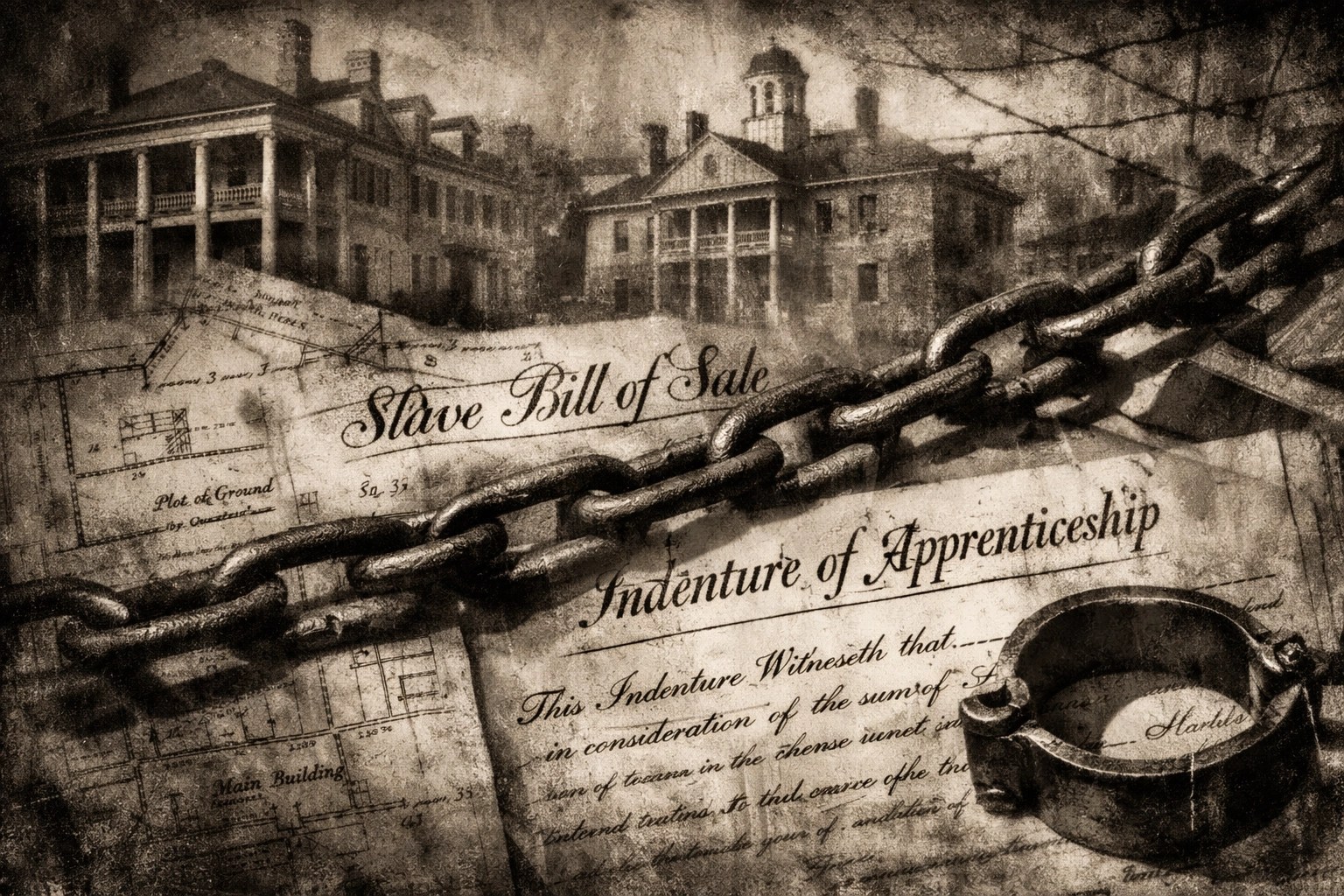
The legal construction of race created artificial divisions among working people
The colonial elite faced a challenge. Nancy Isenberg explains this in White Trash: The 400-Year Untold History of Class in America. They needed to prevent class-based uprisings. The colonial elite faced a challenge. They needed to stop uprisings based on class. The solution? Create a racial hierarchy that gave poor Europeans a stake in the system. Even the lowest white person looked down on Black people. Even the poorest white farmer had someone beneath them in the caste structure.
The Virginia Slave Codes of 1705 codified this into law. For the first time, the term “white” appeared in legal documents, granting privileges based solely on skin color. White servants could own property. White servants had legal protections. White servants could eventually become free. Black people, regardless of skill or status, were permanently relegated to the bottom caste.
This wasn’t natural. This wasn’t inevitable. This was engineered.
Caste: The Framework That Explains Everything
Isabel Wilkerson’s groundbreaking book Caste: The Origins of Our Discontents gives us the clearest framework for understanding American racial hierarchy. She argues that America operates under a caste system, a rigid hierarchy of human ranking based on perceived innate characteristics.
In a caste system:
- Your position is determined at birth
- Your opportunities are limited by your caste
- The system is maintained through law, custom, and violence
- The dominant caste benefits materially and psychologically from the hierarchy
- Social mobility is restricted or impossible
Sound familiar?
Wilkerson identifies eight pillars of caste, but let’s focus on three that defined white culture from the start:
1. Divine Will and the Laws of Nature: The caste system justified itself through religion and pseudoscience. Black people were deemed naturally inferior, closer to animals than humans. White people were God’s chosen, destined to rule.
2. Heritability: Your caste passes to your children. One drop of Black blood made you Black, but any amount of white blood didn’t make you white. The rules were designed to preserve white purity and expand the subordinate caste.
3. Occupational Hierarchy: Certain jobs were deemed appropriate for certain castes. Enslaved people did the brutal labor that built America’s wealth. Poor whites did slightly better work but were kept just comfortable enough not to revolt.

The caste system created rigid hierarchies that determined life outcomes from birth
This framework helps us answer the question: What is white culture?
White culture is the dominant caste’s way of life. It consists of the unspoken rules, privileges, and worldviews that come from sitting atop a racial hierarchy. It’s not a celebration of European heritage. It’s a system of domination dressed up as normalcy.
Who Benefits? The Material and Psychological Wages of Whiteness
Here’s where it gets complex, because the answer isn’t simple.
Yes, white people benefit from white culture. But not equally. And often not in the ways they think.
W.E.B. Du Bois introduced the concept of the “psychological wage” of whiteness in his 1935 work Black Reconstruction in America. He argued that even poor white people were economically exploited by the wealthy elite. Yet, they received compensation in the form of status. They could vote when Black people couldn’t. They could use public facilities. They could insult any Black person without consequence. This psychological wage kept poor whites invested in a system that also oppressed them economically.
Nancy Isenberg’s White Trash expands on this, showing how the white elite used poor whites as a buffer class. Poor whites weren’t truly welcomed into the elite’s world. However, they were given just enough privilege. This stopped them from joining forces with Black people and other people of color. They were hindered in rising up against the true oppressors, the wealthy ruling class.
Cheryl Harris, in her seminal essay “Whiteness as Property,” explains that whiteness itself became a form of property. It could be owned. It also is transferred and legally protected. White people:
- Own land when people of color couldn’t
- Access GI Bill benefits after WWII (documented in The Color of Law by Richard Rothstein)
- Buy homes in suburbs that were legally restricted to whites only
- Attend better schools funded by higher property taxes
- Build generational wealth that compounded over centuries
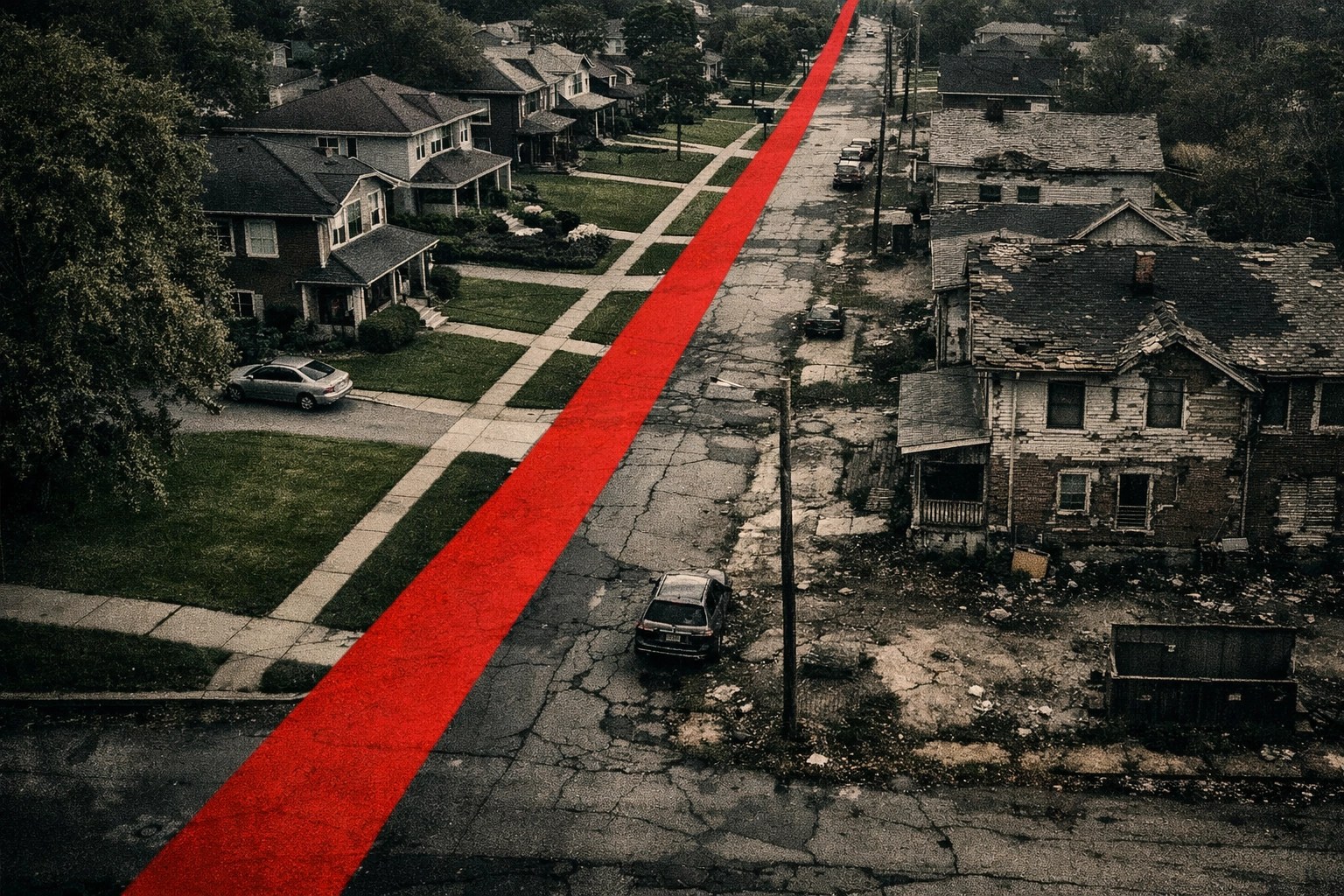
Redlining and housing discrimination created generational wealth gaps that persist today
But here’s the cruel irony: while working-class white people receive psychological benefits from whiteness, they’re also screwed by the system. They’re kept just comfortable enough not to revolt, but not comfortable enough to actually thrive. The white elite hoards the real wealth and power. They throw scraps to poor whites in the form of racial status.
This is why poor white people often vote against their economic interests. They’re protecting their status in the caste system, even when it hurts them materially. Carol Anderson’s White Rage documents this pattern throughout American history. White people were willing to burn down public swimming pools rather than integrate them. They were willing to defund public schools rather than attend them with Black children. They were willing to reject universal healthcare rather than share it with people of color.
It’s cutting off your nose to spite your face. It’s self-sabotage in defense of caste position.
The Ideological Fortress: Why “White Culture” Remains Unnamed
One of the most powerful aspects of white culture is that it presents itself as if it has no culture. It portrays itself as just “normal,” “default,” or “American.”
Think about how we talk about culture in America:
- “Black culture”
- “Latino culture”
- “Asian culture”
- “White… normalcy?”
This erasure is intentional. As long as whiteness remains unmarked and unnamed, it can’t be examined or challenged. It’s like trying to critique air, it’s everywhere, but invisible.
Robin DiAngelo, in White Fragility, explains how white people are brought up in a social environment. This environment insulates them from racial discomfort. When that insulation is challenged, even minimally, they experience disproportionate anger, fear, and defensiveness. This “white fragility” protects the system by making racial conversations so uncomfortable that people avoid them altogether.

White fragility creates an invisible shield protecting the racial hierarchy from examination
This brings us to a critical question: Is racism just white culture rebranded?
Not exactly. But they’re deeply intertwined.
Racism is the system, the laws, policies, and practices that maintain racial hierarchy. White culture is the worldview, the beliefs, behaviors, and norms that emerge from being the dominant caste. You can’t separate them cleanly because each reinforces the other.
White culture tells white people they are individuals. They earned everything they have through merit. On the other hand, they view people of color as groups who want handouts. White culture teaches that racism is about individual bad actors using slurs, not about systems that distribute resources unequally. White culture positions white experiences, perspectives, and aesthetics as universal and neutral, while everything else is “ethnic” or “diverse.”
These aren’t just beliefs. They’re the operating system that runs American institutions.
The Science That Never Was: Debunking Biological Race
Let’s be crystal clear about something: There is no scientific basis for race as a biological category.
Genetic research has definitively shown that there’s more genetic diversity within racial groups than between them. The concept of distinct races with inherent characteristics is pseudoscience, junk science used to justify a social hierarchy.
Dorothy Roberts, in Fatal Invention: How Science, Politics, and Big Business Re-create Race in the Twenty-First Century, documents how racial categories were invented. These categories were created to justify slavery. These categories were then dressed up in scientific language to support colonization. Eugenics movements used fake science to argue for white superiority. Medical experiments on enslaved people (detailed in Deirdre Cooper Owens’s Medical Bondage) treated Black bodies as less than human.
The Human Genome Project proved what anti-racist activists have always known: race is a social construction, not a biological reality. It’s real in its consequences, the wealth gaps, health disparities, and criminal justice outcomes are devastatingly real. But the idea that white people are genetically superior is absolute fiction.
So when we ask “What is white culture?” we’re not asking about biology. We’re asking about power, who has it, how they got it, and how they maintain it.
The Architecture Revealed: From 1619 to 2026
We’ve covered a lot of ground, but let’s synthesize what we’ve learned:
White culture is:
- A legal and social construction created to keep a caste system
- An invented hierarchy that benefits those classified as white
- A worldview that treats whiteness as normal and everything else as other
- A system of accumulated advantage built over 400+ years
- An invisible structure that resists examination and change
White culture is not:
- Biological or scientific
- About European ethnic traditions
- Fixed or unchangeable
- Something that benefits all white people equally
The architecture of white culture was built deliberately. The Virginia Slave Codes marked the beginning. Then came Jim Crow, followed by redlining and the War on Drugs. These are documented in Michelle Alexander’s The New Jim Crow. Each era adapted the system to maintain the hierarchy. This happened even as explicit racism became socially unacceptable.
And now, in 2026, we’re watching a return to explicit hierarchy. The dismantling of DEI programs. The attacks on ethnic studies. The calls for segregation. This isn’t new, it’s the same architecture being reinforced after a period when it felt threatened.
A Call to Action: Building the Mirror
This is Part 1 of our series, and we’ve laid the foundation. In the coming installments, we’ll explore:
- Part 2: The maintenance mechanisms, how white culture perpetuates itself through law, education, and media
- Part 3: The costs, how white culture harms everyone, including white people
- Part 4: The path forward, how we dismantle the architecture and build something new
But here’s what I need you to understand right now: This isn’t about guilt. This is about clarity.
Understanding white culture doesn’t mean hating white people. It means understanding the system we’re all trapped in. Some of us have privileges. Some of us face penalties. Yet, all of us are limited by a caste structure that stunts human potential.
We can’t have unity without truth. We can’t have healing without accountability. And we can’t dismantle what we refuse to name.
So let’s name it. Let’s examine it. And let’s commit to building something better. We want a true multiracial democracy where culture is celebrated, not weaponized. In this democracy, caste should be a relic of our brutal past, not our unchangeable future.
The mirror is being held up. The question is: Are we brave enough to look?
Sources
- Hannah-Jones, Nikole. The 1619 Project. Random House, 2021.
- Isenberg, Nancy. White Trash: The 400-Year Untold History of Class in America. Viking, 2016.
- Wilkerson, Isabel. Caste: The Origins of Our Discontents. Random House, 2020.
- Rothstein, Richard. The Color of Law: A Forgotten History of How Our Government Segregated America. Liveright, 2017.
- Anderson, Carol. White Rage: The Unspoken Truth of Our Racial Divide. Bloomsbury, 2016.
- DiAngelo, Robin. White Fragility: Why It’s So Hard for White People to Talk About Racism. Beacon Press, 2018.
- Alexander, Michelle. The New Jim Crow: Mass Incarceration in the Age of Colorblindness. The New Press, 2010.
- Harris, Cheryl I. “Whiteness as Property.” Harvard Law Review, Vol. 106, No. 8, 1993.
- Roberts, Dorothy. Fatal Invention: How Science, Politics, and Big Business Re-create Race in the Twenty-First Century. The New Press, 2011.
- Cooper Owens, Deirdre. Medical Bondage: Race, Gender, and the Origins of American Gynecology. University of Georgia Press, 2017.
Please Subscribe, Follow, Like, Comment on Substack, Youtube, IG, LinkedIn, & FB.
Stay tuned for Part 2: The Maintenance Mechanisms: How White Culture Perpetuates Itself Through Law, Education, and Media, coming soon.
This conversation is just getting started, and we need your voice in it. Share this article. Challenge these ideas. Engage with the sources. Let’s build understanding together.
About the Author
PoppaDukes Serrano is the Executive Producer and Host of The OG Social Network Podcast. The podcast covers the intersection of cannabis, culture, politics, and community in New York. PoppaDukes has deep roots in advocacy. He is committed to amplifying marginalized voices in the industry. PoppaDukes brings the street cred and real talk that the community conversation needs. Follow the podcast for unfiltered conversations with the trailblazers, entrepreneurs, politicians, and activists shaping the future.